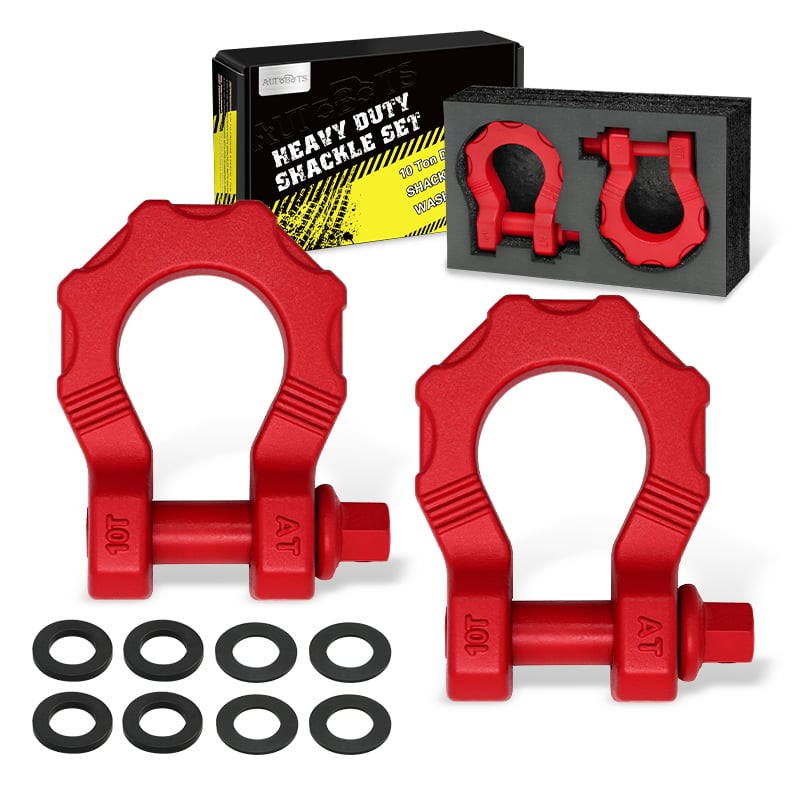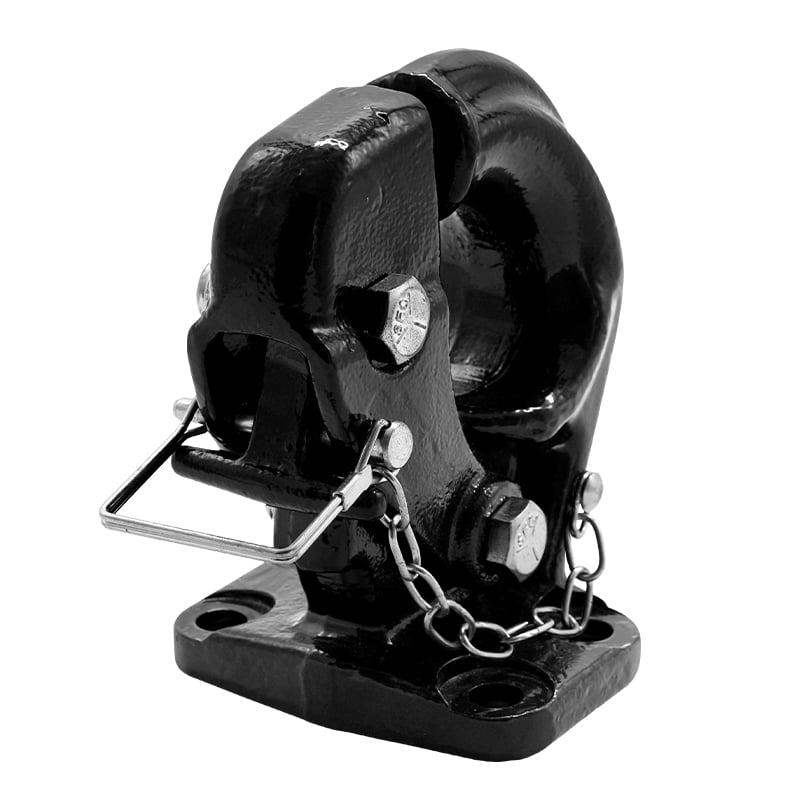

A 2-in receiver that clunks over every expansion joint is not a nuisance — hitch rattle is a measurable clearance condition. For fleet managers and engineers it means impact loads, pin wear, and weld fatigue. This article covers where the gap comes from, what it does under load, and which towing accessories solve it at the tolerance level.
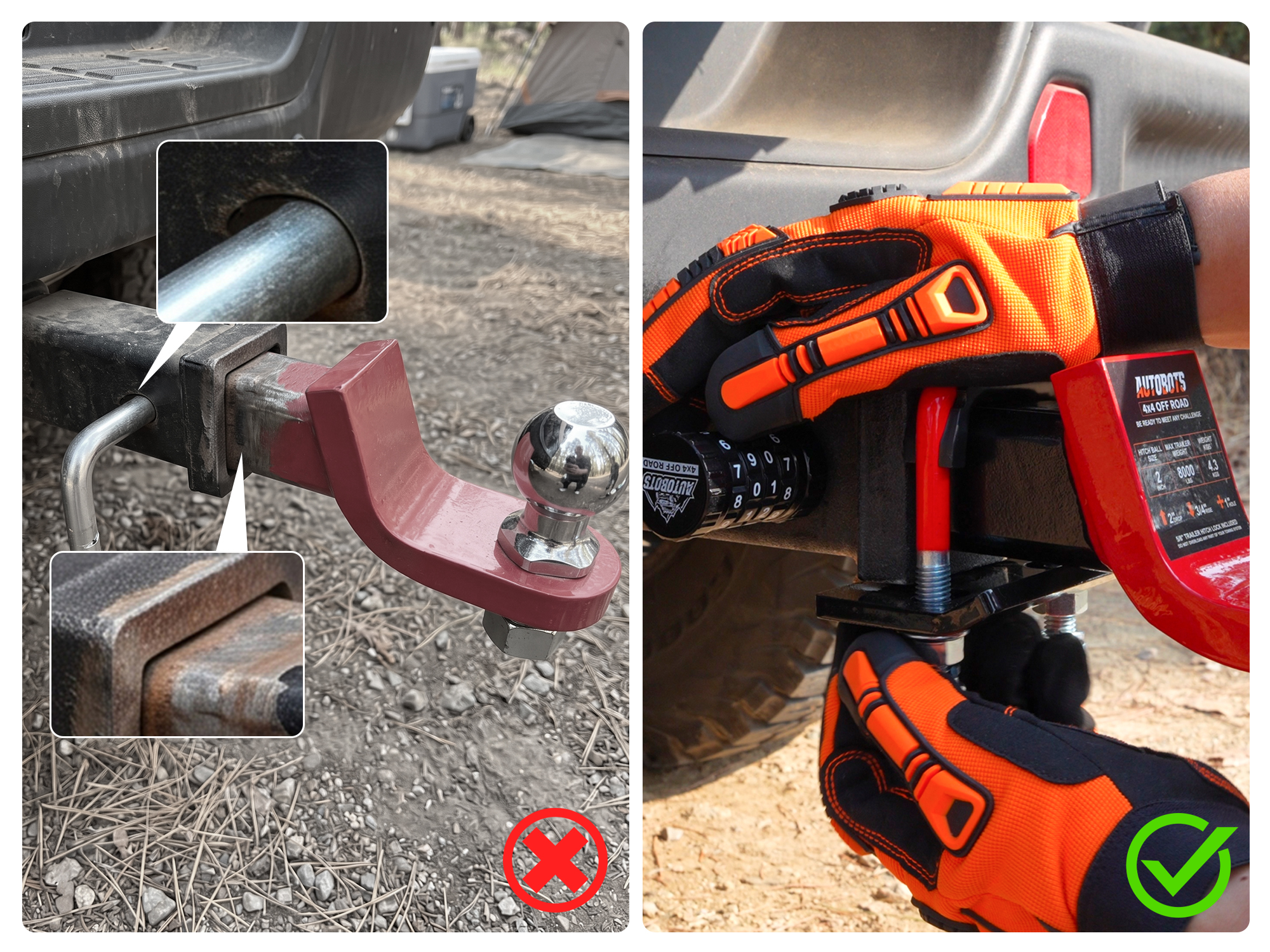
The 2-in receiver is a clearance fit: "2 inches" is nominal, not actual. Receiver tubes open oversize — typically +0.010 to +0.030 in on the bore — because the welded tube distorts at the seam. Ball-mount shanks are drawn to the lower band, 1.990–1.998 in. Stack the extremes and total fit clearance reaches 1/16 in (0.060 in) before the first mile. Production hitches typically ship with 0.030–0.060 in of play — which is why some hitch rattle exists in every rig from day one.
Impact Loads, Not Just Noise
Clearance turns static into dynamic load. Every brake or acceleration event slams the mount across the gap into the wall; at 5,000-lb tongue weight the impact far exceeds static force, hammering through coupler and frame. Hitch rattle is the symptom; impact loading is the disease.
Pin Bore Wear and Oval-Out
With clearance, the pin hammers fore-and-aft until the bore elongates — oval out. A 5/8-in bore at 0.645 in can reach 0.660 in a season; that wear feeds back into worse hammering. Hitch pin wear is a positive-feedback loop.
Low-Speed Rattle vs. High-Speed Oscillation
Clunking under 25 mph is pure clearance impact, fixed by tightening; oscillation above 55 mph is a stability problem of geometry and mount stiffness. Receiver slop aggravates it but does not cause it — never sell a tightener as a sway cure.
Engineering the Fix: Tighteners, Wedges, Shims, and Sleeves
All solutions fall into two families: eliminate the gap (shims, wedges) or preload the interface (bolt-down tighteners, friction sleeves). A good hitch tightener does both — the starting point of fleet-standard hitch rattle control.
Bolt-Down Tightener
A clamp bolt presses the shank against the opposite wall; 30–50 ft-lbs of preload holds solid contact. Zero residual play and adjustable — but torque needs re-checking, and overtightening can distort thin walls.
Wedge Tightener
A tapered wedge converts wrench effort into high normal force via the taper angle. Rigid per pound of hardware — seats can loosen under vibration.
Shim Packs
Shims fill the measured gap. A hitch shim is cheap and effective but static: it fixes installation-day clearance, not later wear; dissimilar-metal contact invites corrosion.
Friction Sleeves
A polymer or brass sleeve kills metal-to-metal contact; interference plus friction absorbs impact energy. Quiet and protective, but it wears out.
| Solution | Principle | Install Cost | Durability | Best-Fit Scenario |
| Bolt-Down Tightener | Clamp preload closes the gap | Moderate | High; re-torque monthly | Mixed fleets, daily coupling |
| Wedge Tightener | Taper converts bolt torque to normal force | Low | Medium; seats may loosen | Light-to-medium duty |
| Shim Pack | Fills the measured gap with precision stock | Low | Medium; no wear compensation | Defined-clearance rigs |
| Friction Sleeve | Interference fit absorbs impact energy | Low | Medium; replace periodically | Noise-sensitive urban trailers |
At some point the noise is a worn component, not a fit issue. Measure the bore on the load axis and 90° off: elongation beyond 0.010–0.015 in over nominal puts the receiver past service limits — a new trailer hitch ball mount will not fix an oval bore; replace the receiver. Out-of-square mouth, bowed wall, or weld-toe cracks mean overload or fatigue — retire the unit. If total clearance exceeds 1/8 in with a straight shank, the system is worn, not loose — the point where hitch rattle becomes a wear indicator.
Standardize hitch rattle control like tire pressure: interval, value, torque spec.
Monthly clearance check at the pin, logged; a 0.010-in jump means accelerating wear.
Torque re-check: 500 miles after install, then monthly — 30–50 ft-lbs by torque wrench, never by feel.
Lubrication: anti-seize on shank, pin, and threads; rust scale is grit that accelerates hitch pin wear and freezes adjustments.
Pin, lock, and chain: inspect for galling; pair with a hitch pin lock and the safety-chain routine.
Ball and mount: annual dimensional check of the trailer hitch ball and shank.
Pro Tip — Track the Gap, Not the Noise. Mark the shank and measure at the same clock position monthly; a 0.010-in jump beats a year of logged rattling hitch noise. Record cold clearance before installing any tightener; keep a 0.010-in shim in each truck.
autobots4x4.com is the export arm of Qingdao Huilisheng Rigging Hardware Product Co., Ltd. — factory-direct B2B manufacturing for US, Australia, UK, Germany, and Middle East. Standardizing an anti rattle hitch across a fleet or sourcing tighteners for a catalog? We deliver consistent tolerance, batch-level QC, and OEM labeling — hitch rattle solved at the source.
Request your free 2026 product catalog and wholesale pricing: email [email protected] or WhatsApp +86-15863460168. Factory-direct, full export documentation.
 Hot News
2026-05-29
2026-05-22
2026-05-14
2026-01-29
2026-01-23
2026-01-10
Be the first to get our latest styles and offers.
Building7, Rubber Valley Tower, Qingdao, Shandong, China
Copyright © Qingdao Huilisheng Rigging Hardware Product Co., Ltd. All Rights Reserved - Privacy Policy
 EN
EN